
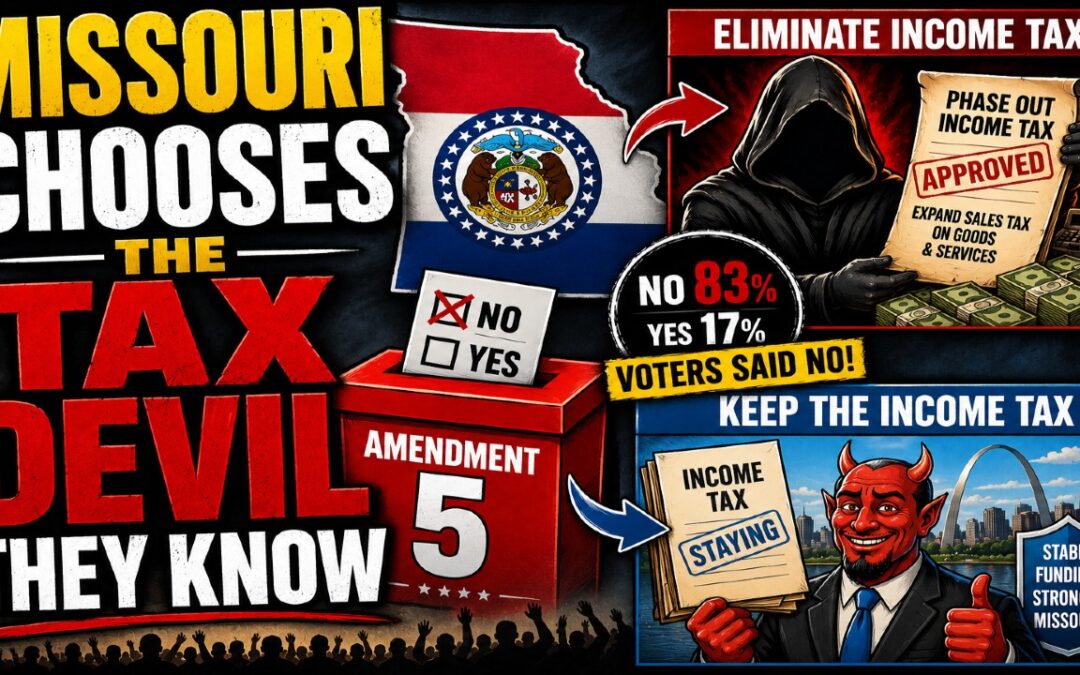
MISSOURI VOTERS REJECT SALES TAX PLAN
Uncertainty Causes Voters to Embrace the Devil They Know
Voters in Missouri had a rare chance to free themselves from the hassle and costs of the state’s personal income tax. Sadly, they rejected the move. The state legislature placed Amendment 5 before the voters on August 4, 2026. That would have put Missouri on track to eliminate its individual income tax and replace the revenue with a broad-based sales tax, something I’ve advocating since 1993.
What was Amendment 5?
Amendment 5 would have authorized the phase-out and eventual permanent abolition of the state’s individual income tax. It would give the legislature authority to replace the revenue with higher and broader sales taxes. Here are the specifics.
- Eliminate the individual income tax. Missouri’s current top individual rate is 4.7%. It would have been phased-out under the plan.
- Replace the revenue with sales taxes. For a five-year period, lawmakers would have been given authority to increase the sales tax rate and expand the base to goods and services not currently taxed. They could do so without obtaining voter approval for each change. Sales tax increases imposed under that authority had to be paired with corresponding income tax reductions. The goal was to completely abolish the income tax within that period.
- No future income tax. Once the income tax was eliminated, the state would have been constitutionally prohibited from imposing an individual income tax in the future.
The shift from income taxes as the primary source of the state’s revenue—about 64 percent, or $8.5 billion—to consumption taxes, most certainly would have encouraged investment within the state and would have spurred overall economic growth. I have written about this point repeatedly over the years. Generally speaking, consumption taxes are more favorable to growth then income taxes because the income tax burdens production, which is the very engine of economic growth.
So What Went Wrong?
Voters overwhelming rejected the amendment by 66 percentage points: 83.3% “No” to only 16.7% “Yes.” The likely reason for the lopsided result is the uncertainty in the proposal.
Because the state’s income tax collects about $8.5 billion annually, that revenue would have to be replaced with new sales tax revenue. Fine; that’s the essence of the plan. That would mean higher sales tax rates and a broader base. In addition, spending reductions would also likely be required. That’s fine too as there’s little doubt in my mind that substantial savings can be found in simply eliminating waste, fraud and duplication.
But the specifics of these elements were never defined.
Voters were asked to authorize the elimination of the income tax without being told precisely what the replacement sales tax rate would be. Likewise, there was no clarity on exactly which currently untaxed goods and services would become taxable under the expanded base. Moreover, there was no discussion of what specific spending cuts might be on the table. The legislature would have worked out those details later. Opponents argued that cuts would be targeted at essential services and public education.
In light of this, voters apparently opted to stick with the devil they know rather than embrace the one they don’t.
The Postmortem
While a broad-based sales tax is undeniably a better idea than income taxes, the lesson here is, as Jefferson said in the Declaration of Independence, “mankind are more disposed to suffer, while evils are sufferable, than to right themselves by abolishing the forms to which they are accustomed.”
Most people seem to hate the income tax, but the idea of abolishing it without a clearly defined and measurable alternative, proved unacceptable to Missouri voters. This means that all future attempts at dismantling a state’s income tax system must be well-defined and “mathed-out” in a manner that people can understand, grasp, and get behind.
Short of that, you have to expect people to simply endure the suffering imposed by the income tax system.
Watch Dan’s Podcast on this topic: https://youtu.be/2sJkrP0oGyA
_______________________
Want to read the of this months PTT issue?
PTT subscribers get the entire version of articles, special reportst (including links)
and more valuable insights when they download their issue of Pilla Talks Taxes.
Looking for a single issue? Contact our office for pricing.
____________________
Articles found in the latest
PILLA TALKS TAXES ISSUES:
OCTOBER
PRESIDENT TRUMP’S $5,000 BRIBE
The Only Real Promise is More Debt
MOVEMENT ON THE TAS ACT
Full Senate Now has the Bill
BOI REPORTING RULE IS DEAD
Small Businesses Catch a Break
INTERACTING CODE SECTIONS PUT BURDEN ON IRS
Procedural Requirements are not Mere Details by Scott MacPherson
EIGHT CIRCUIT SUSTAINS TAX COURT’S RULING ON BOECHLER
Equitable Tolling Not Justified
HOW LONG SHOULD YOU KEEP YOUR RECORDS?
The Answer is Disturbing
Video Blog: https://youtu.be/u5ffdqKzfU0
SEPTEMBER
IRS’s OFFICE OF PROFESSIONAL RESPONSIBILITY
SPEAKS OUT ON AI
Your Ethical Responsibilities Haven’t Changed
THE COVID-19 EMERGENCY DECLARATION
How Will it Affect IRS Interest Assessments?
THE TAXPAYER ASSISTANCE AND SERVICE ACT
Bill is Making Progress in the Senate
MISSOURI VOTERS REJECT SALES TAX PLAN
Uncertainty Causes Voters to Embrace the Devil They Know
______________
LOOKING FOR A SPECIFIC TOPIC?
Check out prior issues by using the
INDEX of PILLA TALKS TAXES articles
LOOKING TO STAY CURRENT ON THE LATEST TAX CHANGES?
Dan Pilla' monthly newsletter, Pilla Talks Taxes, features news stories and developments in federal taxes that effect your pocket book. Each information packed issue shows you how to use little known strategies to cut your taxes, protect yourself from the IRS, exercise important taxpayers' rights and keeps you up to date on the latest trends in Washington on the important subjects of taxes and your rights. You can't afford to miss a single issue!
10 issues per year. $99.00 per yr
Click here for more information on PTT articles and subscription options.
An email address is required to receive this newsletter.
--------------------------
LOOKING FOR A SPECIFIC TOPIC?
Check out our
INDEX of PILLA TALKS TAXES articles